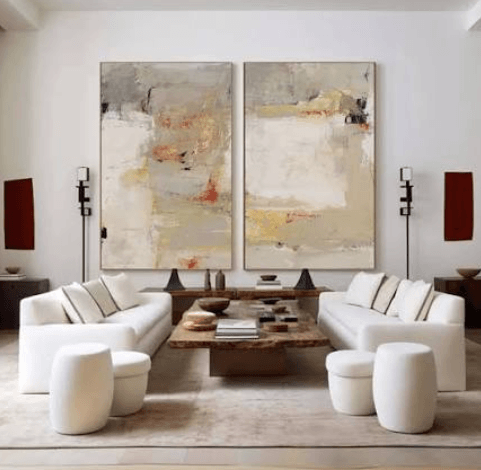
People use these two terms almost interchangeably, and honestly, it’s easy to see why. Both styles favor calm color palettes. Both avoid clutter. Both look “simple” at first glance. But stand a minimalist piece next to a Wabi Sabi one, and you’ll notice they’re actually doing pretty different things. One is about precision. The other is about letting go of precision entirely. That distinction matters more than it seems once you’re trying to pick art for your own home.
The Quick Answer
Minimalist art is about reduction — stripping a composition down to its simplest, cleanest form. Wabi Sabi art is about imperfection — embracing rough edges, asymmetry, and a sense of age or wear. Minimalism is controlled. Wabi Sabi is organic. That’s really the core of it, though there’s more nuance worth unpacking.
What Defines Minimalist Wall Art
Minimalism is rooted in restraint. A minimalist piece usually has a very limited color palette, clean and often geometric shapes, and a lot of intentional negative space. Nothing is accidental. Every line, every gap, every color choice feels deliberate, almost engineered.
If you look closely at a minimalist painting, you’ll notice the edges tend to be crisp. The shapes are usually symmetrical or at least carefully balanced. There’s a precision to it that feels closer to design than to raw, expressive art. It’s calm because it’s controlled, not because it’s loose.
This is the kind of style you’ll find in a minimalist paintings collection — pieces built around clean lines, quiet color palettes, and compositions that feel precise rather than accidental. Nothing about it looks like it happened by chance.
What Defines Wabi Sabi Wall Art
Wabi Sabi comes from a completely different place. It’s a Japanese philosophy centered on finding beauty in imperfection and impermanence. Applied to art, that means rough textures, uneven edges, muted earthy tones, and compositions that feel more organic than engineered.
Where minimalism is precise, Wabi Sabi is deliberately imprecise. A crack might be left visible instead of smoothed over. A line might wobble instead of staying perfectly straight. The color palette tends to lean warmer and earthier too — clay, sand, moss, charcoal — rather than the starker whites, blacks, and grays common in minimalist work.
It’s not sloppy, though. That’s the part people misunderstand. A good Wabi Sabi piece still takes real skill to create. The imperfections are shaped with intention, even if the final result looks loose and natural.
Side-by-Side: Key Differences
Color palette. Minimalism often leans cool and neutral — white, black, gray, sometimes a single bold accent. Wabi Sabi leans warm and earthy — terracotta, sand, moss, muted browns.
Line and shape. Minimalist pieces favor clean, often geometric lines. Wabi Sabi favors organic, slightly irregular shapes and edges.
Texture. Minimalism is usually flat or smooth. Wabi Sabi frequently uses raised, uneven, or rough texture as a core part of the composition.
Feeling. Minimalist art tends to feel crisp, modern, almost architectural. Wabi Sabi feels grounded, warm, and a little weathered.
Precision. Minimalism is about getting the composition exactly right. Wabi Sabi is about letting things be a little wrong, on purpose.
Which One Fits Your Home Better?
Choose Minimalist If…
Your space already leans modern, with clean furniture lines and a cooler color scheme. Minimalist art tends to blend seamlessly into that kind of environment, reinforcing the same sense of order and precision rather than fighting against it.
It’s also a strong choice if you want art that fades slightly into the background — present, but not demanding attention every time you walk past it.
Choose Wabi Sabi If…
You’re drawn to warmth, texture, and a sense of history in your decor. Wabi Sabi pairs beautifully with natural materials — wood, linen, stone, unglazed ceramics — and tends to suit homes that already lean cozy or rustic rather than sleek and modern.
It’s also a great option if you find pure minimalism a little too cold or sterile. Wabi Sabi keeps things simple without losing warmth in the process.
Can You Mix the Two Styles?
Yes, actually, and a lot of the most interesting homes do exactly that. A crisp minimalist piece in one room and a warmer, textured Wabi Sabi piece in another can work really well together, especially if there’s some shared color connection tying the spaces together.
Even within the same room, pairing a clean minimalist painting with a textured, earthy accent (a ceramic vase, a woven basket) can bridge the two aesthetics without feeling disjointed. The key is not mixing them too closely on the same wall, where the contrast between crisp and rough can start to feel like a mistake rather than a choice.
If your space already trends neutral, a piece from a neutral wall art collection built around Wabi Sabi principles can add texture and warmth without pulling the room away from that calm, understated base you’ve already established.
A Simple Way to Remember the Difference
Think of minimalism as a single, perfectly drawn line on white paper. Every bit of that line was intentional and controlled.
Now think of Wabi Sabi as a line drawn by hand, slightly uneven, maybe smudged in one spot, on paper with a bit of natural texture. It’s still simple. It’s still calm. But it feels like it came from a hand, not a ruler.
Neither is more “correct” than the other. They’re just built on different ideas about what makes something beautiful.
See also: Rafer Discount: How Verified Deals Are Helping Small Businesses Compete With Big Retailers
FAQ
Is Wabi Sabi just a rougher version of minimalism?
Not exactly. They share some surface qualities, like restraint and simplicity, but they come from different philosophies. Minimalism values precision and control. Wabi Sabi values imperfection and impermanence. The intent behind each is genuinely different, not just the finish.
Can minimalist and Wabi Sabi art be used in the same room?
Yes, as long as they’re not placed too close together. Different walls in the same room, or the same wall with some distance between pieces, usually works better than hanging them side by side, where the contrast can feel more like a clash than a choice.
Which style is easier to decorate around?
Minimalist art is generally a bit easier to match, since it tends to use a narrower, more neutral color range. Wabi Sabi requires a little more thought around texture and warmth in the surrounding decor, but it rewards that effort with a cozier, more grounded feel.
At the end of the day, both styles are trying to create calm — they just take different paths to get there. One does it through control, the other through letting go a little. Which one feels more like your home probably says more about you than either style ever will on its own.