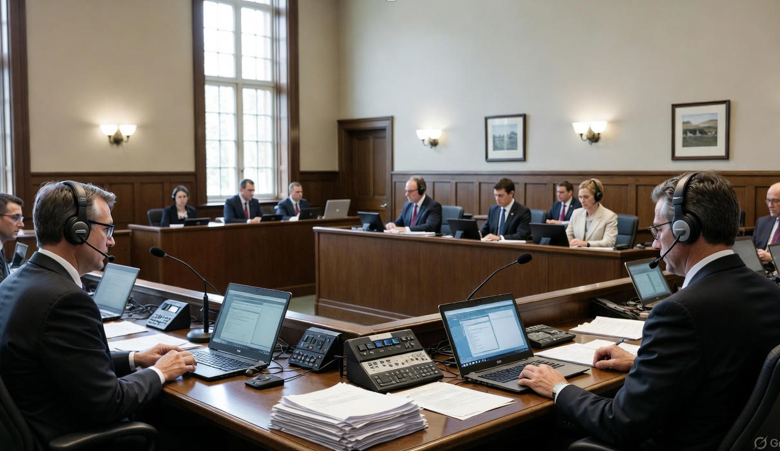
In the bustling legal corridors of Spokane, Washington, court reporters are at the forefront of a rapidly evolving industry. As the demand for accurate and timely legal documentation continues to rise, professionals in this field are adapting to technological advancements and addressing a nationwide shortage of skilled workers. This comes at a time when the judicial system relies more than ever on precise records to ensure justice is served efficiently.
The Essential Role in Spokane’s Legal System
Court reporters play a critical yet often underappreciated role in the administration of justice. They are responsible for creating verbatim transcripts of court proceedings, depositions, and other legal events. In Spokane, home to the Spokane County Superior Court, these professionals ensure that every word spoken in the courtroom is captured accurately, providing an indispensable resource for attorneys, judges, and litigants alike.
The Spokane County Superior Court, which handles a wide array of cases from civil disputes to criminal trials, depends on reliable transcription services to maintain the integrity of its records. According to county resources, a list of approved transcriptionists includes dozens of qualified individuals, many based locally, who support the court’s operations. This list features professionals like Kenneth Beck from Spokane, who offers services with contact details for easy access by legal teams.
Beyond the courtroom, court reporters in Spokane extend their expertise to depositions, arbitrations, and even remote proceedings. The city’s legal community benefits from a network of firms that provide comprehensive support, helping to streamline complex cases in a region known for its mix of urban and rural jurisdictions.
Local Firms Leading the Way
Several established companies dominate the court reporting landscape in Spokane. One prominent provider is NAEGELI Deposition & Trial, which has carved out a niche with its blend of traditional skills and modern technology. Operating from a historic location in the East Side Carnegie Library, NAEGELI offers a suite of services including court reporting, legal transcription, videography, and remote depositions. Their team emphasizes accuracy and responsiveness, making them a go-to choice for attorneys handling high-stakes cases.
Other notable firms include U.S. Legal Support, which boasts a network of vetted reporters for onsite and remote services, and Veritext, known for its experienced reporters who provide realtime streaming during depositions. M&M Court Reporting, serving both Spokane and nearby Coeur d’Alene, Idaho, focuses on reliability and cost-effectiveness, while Crumb Court Reporting prides itself on delivering high-quality products at reasonable rates.
These firms not only cater to local needs but also adapt to the unique challenges of Spokane’s geography. With cases often spanning from the urban center to outlying areas, mobility and technological flexibility are key. For instance, Buell Realtime Reporting offers swift transcription services that integrate seamlessly with litigation processes.
In a competitive market, client reviews highlight the importance of professionalism and timeliness. Yelp listings for top court reporters Spokane services often praise firms like Inland Court Reporters and Central Court Reporting for their dedication to excellence.
See also: Personal Injury Lawyers Helping You Get Justice Quickly
National Trends Impacting Spokane
The court reporting industry is undergoing significant transformations, as outlined in the 2025 Court Reporting Industry Trends Report by the American Association of Electronic Reporters and Transcribers (AAERT). The report reveals a 21% decline in the number of stenographers over the past decade, with only about 23,000 remaining nationwide. This shortage is exacerbated by an aging workforce, where 81% of stenographers are 45 or older, and a sharp drop in enrollment at stenography schools.
In Spokane, these trends manifest in scheduling difficulties and rising costs. Legal professionals report that 76% face challenges in booking reporters, leading to procedural delays in 39% of cases. To counter this, there’s a growing adoption of digital court reporting, which now accounts for 30% of usage and offers faster transcript delivery without compromising accuracy.
Technology is a bright spot in this narrative. Artificial intelligence (AI) tools are revolutionizing transcription, enabling natural language processing for quicker and more precise outputs. In Spokane, firms are integrating AI with human oversight to handle multilingual cases and complex legal jargon. Remote depositions, accelerated by the pandemic, have become standard, allowing reporters to participate from anywhere using secure platforms.
The report emphasizes accuracy as the top priority, with 96% of users citing it as their key performance indicator. This aligns with local practices, where firms like Vernon Court Reporters ensure meticulous records through certified experts.
Challenges and Adaptations
Despite the advancements, challenges persist. The shortage has led to increased workloads and higher fees, with 55% of end users noting cost escalations. In Spokane, where the legal caseload includes everything from family law to environmental disputes, this can strain smaller firms and solo practitioners.
Adaptation strategies include diversifying between traditional stenography and digital methods. Local transcriptionists, such as those on the county’s approved list, offer flexible services to fill gaps. For example, Amy Brittingham from nearby Naches provides transcription for various legal needs, while Spokane-based Robin Dean specializes in audio-to-text conversions.
Training and education are also pivotal. With a 74% drop in stenography school enrollment nationally, initiatives to attract younger talent are crucial. In Washington State, programs emphasize hybrid skills, combining shorthand with digital tools to prepare reporters for modern demands.
Moreover, the integration of video synchronization and realtime streaming is enhancing evidence presentation. Firms in Spokane are leveraging these to support trial preparations, reducing the time from deposition to courtroom use.
Looking Ahead: A Hybrid Future
As we look to the future, the court reporting sector in Spokane is poised for a hybrid model that blends human expertise with technological innovation. The global legal technology market is projected to reach $50 billion by 2027, signaling robust growth in tools that support efficiency.
Experts predict that by embracing AI and remote capabilities, Spokane’s legal community can mitigate the shortage’s impacts. “The future is about flexibility and accuracy,” notes the AAERT report, recommending that firms budget for innovations while verifying quality.
In conclusion, court reporters in Spokane are not just surviving industry shifts—they are thriving by adapting to new realities. As the judicial system evolves, these professionals remain the guardians of the record, ensuring that justice in the Inland Northwest is documented with unwavering precision.