For many content teams, the initial honeymoon phase with generative AI has ended, replaced by the practical reality of production bottlenecks. The “magic” of entering a short phrase and receiving a masterpiece is a myth that falls apart under the pressure of brand guidelines and specific compositional requirements. In professional environments, the goal isn’t just to generate an image; it is to arrive at a specific visual outcome with the least amount of computational waste and human hours.
When working within the Nano Banana ecosystem, the difference between a frustrated designer and a productive one usually comes down to their understanding of the iteration loop. High-quality output is rarely the result of a single, perfectly phrased prompt. Instead, it is the product of a disciplined feedback cycle that treats text as a secondary guide and source assets as the primary anchor.
The Efficiency Gap in Generative Content Workflows
The current discourse around “prompt engineering” often focuses on the wrong variables. Many operators spend hours tweaking adjectives or adding weight to “4k” or “hyper-realistic” tags, hoping the model will eventually guess their intent. This is a high-entropy approach. Every time a user clicks “generate” on a raw text prompt, they are asking the model to navigate a nearly infinite latent space without a map.
Content teams testing generative media workflows frequently fall into this “prompt hacking” trap. They treat Banana AI as a slot machine rather than a production tool. The efficiency gap appears when the time spent “rerolling” exceeds the time it would have taken to manually composite a reference image.
True creative direction in the Nano Banana environment involves narrowing the model’s choices. Rather than asking the model to imagine everything from the ground up, successful workflows use a combination of structured prompts and visual constraints. This reduces the inference cycle from a random search to a targeted refinement process. The transition from a prompt-first to an asset-led mindset is what separates hobbyist experimentation from professional asset production.
Weighting the Input: Text vs. Source Assets in Nano Banana
The architecture of Nano Banana allows for a sophisticated interplay between semantic instructions (text) and spatial instructions (source images). Understanding how the engine weights these inputs is critical for reducing the number of failed iterations.
Text prompts function best as stylistic and thematic filters. They define the “what” and the “how”—the subject matter and the artistic style. However, text is notoriously bad at describing precise spatial relationships, lighting angles, or the exact curvature of a product’s silhouette. This is where source assets become the dominant factor.
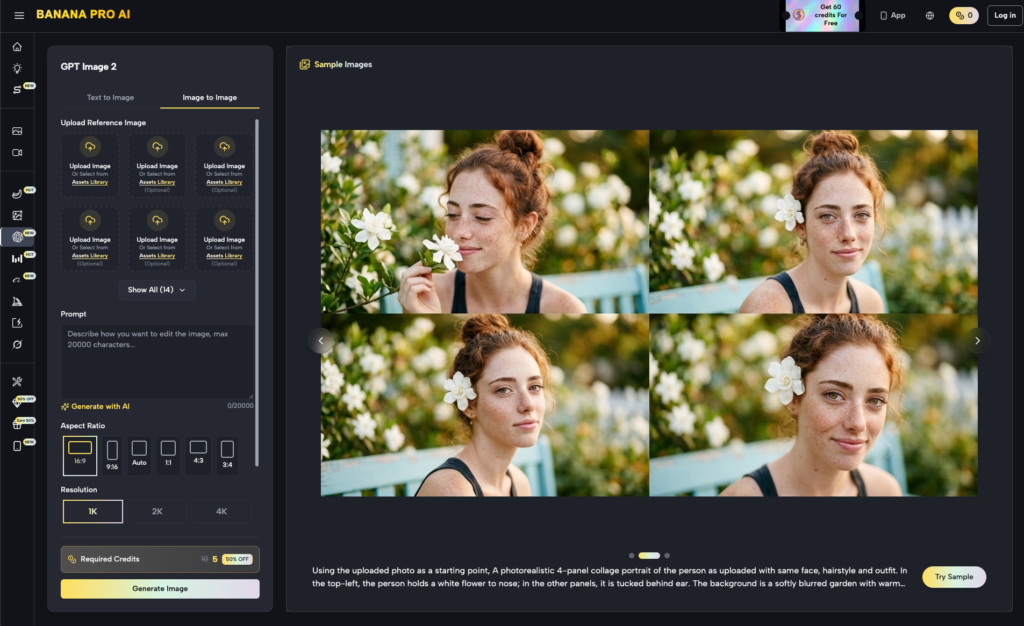
By providing a reference image, you are giving the model a geometric foundation. When you combine this with the text-to-image capabilities of Banana AI, you are effectively “pinning” certain pixels while allowing others to remain fluid. This method drastically reduces the randomness of the output.
There is, however, a point of diminishing returns. Adding more than a dozen descriptive adjectives to a prompt often leads to “prompt bleeding,” where the model becomes confused by conflicting instructions. For example, if you ask for a “minimalist, neon-drenched, rustic, futuristic” scene, the model may default to a generic average of those terms. It is often more effective to use a simple prompt for the core subject and rely on a high-contrast source image to dictate the lighting and composition.
When Prompting Fails: The Transition to Surgical Editing
One of the most common mistakes in AI content creation is staying in the generation phase too long. There is a “90% threshold” where an image is almost perfect, but features a minor anatomical error, a stray artifact, or a slight inconsistency in texture.
The amateur response is to try to “prompt out” the error by adding “no extra fingers” or “clean background” to the negative prompt. This rarely works because the model’s seed has already established the core geometry of the image. The professional response is to exit the generation loop and enter the editing loop.
This is where the AI Photo Editor becomes the primary tool. Surgical editing—using inpainting or localized adjustments—is significantly faster than rerunning 20 generations in the hope that the model will fix its own mistake. If the composition is correct but the lighting on the subject’s face is slightly off, using a dedicated AI Photo Editor allows the creator to mask that specific area and regenerate only that portion.
This transition represents a shift from “creation” to “correction.” It acknowledges that while generative models are excellent at broad-stroke synthesis, they lack the specific intent required for final polish. By utilizing an AI Photo Editor for localized refinements, a team can salvage a “near-miss” generation that would otherwise be discarded, thus protecting the project’s velocity.
Diffusion Dynamics and the Limits of Predictive Control
It is important to maintain a level of skepticism regarding the current state of generative technology. Despite the advancements in Nano Banana, there are inherent limitations that no amount of prompt engineering can fully solve.
First, there is the issue of “stochasticity.” Even with identical prompts and seeds, slight variations in the inference environment can lead to different results. This randomness means that “perfect consistency” across a series of images remains a challenge. If a brand requires a character to look exactly the same across 50 different poses, a simple text-to-image workflow will likely fail.
Second, high-fidelity typography and complex physics remain significant hurdles. Nano Banana, like most diffusion models, treats text as a visual pattern rather than a semantic string. This often results in “hallucinated” letters or nonsensical geometry in architectural renders. We must accept that certain elements are currently better handled through traditional graphic design software after the AI has done the heavy lifting of the background and lighting.
Furthermore, human oversight is not just a quality control measure; it is a necessity for brand safety and visual logic. A model might generate a visually stunning image that is physically impossible—such as a shadow falling in the wrong direction relative to the light source. Without a human editor to catch these “logical hallucinations,” the output remains an experiment rather than a professional asset.
See also: Mastering Index Technical Analysis for Consistent Profits in India
Standardizing the Production Loop for Content Teams
To scale the use of Nano Banana within a team, the workflow must be standardized. This moves the process away from individual “prompt wizards” and toward a repeatable pipeline. A reliable structure for this loop generally follows three distinct phases:
- Concept Anchoring: Instead of starting with a blank prompt box, begin with a mood board or a basic sketch. Use this as your source asset. The initial generations should focus solely on getting the composition and “vibe” right, ignoring small details or minor artifacts.
- Iterative Refinement: Once the composition is locked, use the best-performing seed to generate variations. This is where the prompt is refined to dial in the textures, color palettes, and specific subject details. The goal here is to reach that 90% accuracy mark.
- Localized Editing: Move the asset into the AI Photo Editor. Address the “last 10%” through masking and inpainting. This is the stage where you fix the small errors—the distorted hands, the blurred background elements, or the inconsistent shadows.
By setting a time-cap on the “Iterative Refinement” phase, teams can avoid the trap of endless rerolling. If a generation isn’t perfect after five or ten attempts, it’s a sign that the problem should be solved in the editing phase rather than the generation phase.
The integration of Nano Banana into existing design workflows—rather than treating it as a standalone “magic box”—is the only way to achieve consistent, high-quality results. It requires a blend of creative intuition and technical restraint. Ultimately, the quality of the output is determined not by the complexity of the AI, but by the discipline of the loop that surrounds it. Focusing on precision over randomness ensures that the tools serve the creator’s vision, rather than the other way around.