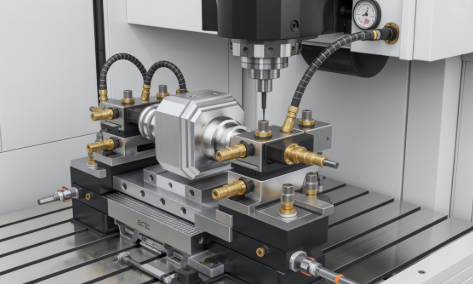
The accuracy of making products depends on maintaining the piece of work throughout machining. Even the most sophisticated CNC machine or cutting tools would not yield accurate results if the workpiece shifts or vibrates. This is overcome by using hydraulic clamping systems.
The nature of accuracy, repeatability and speed is imperative in the manufacturing environment. In precision machining, the company employs very precisely regulated workholding techniques to maintain every part within precisely controlled tolerances. Another mechanism used to ensure consistent machining is hydraulic clamping.
Knowledge of the functions of hydraulic clamps and their use in industry is important for precision production.
What Is a Hydraulic Clamping System?
A hydraulic clamping system is a technology that firmly holds a workpiece during machining or assembly using hydraulic pressure. It provides a uniform clamping force using pressurized fluid rather than manual or mechanical clamping.
Hydraulic clamping pins the parts in place throughout machining. This consistency enables cutting tools to function at the greatest accuracy, reducing any movement and vibration. The commonest hydraulic clamping system incorporates the following components:
- A pressure-generating hydraulic pump.
- Equipment used to provide force to clamps, e.g. clamping cylinders or clamping pistons.
- The fluid pressure is conveyed using hydraulic lines.
- A dynamic control mechanism that affects the force of clamping.
These elements can be operated as a hydraulic clamping unit, providing controlled, repeatable force to firmly fix components during the production process.
Why Is Workholding Important in Manufacturing?
Before discussing hydraulic systems, it is important to understand the role of workholding in machining. Workholding is the process of securing a workpiece during manufacturing. Even minor shifts during machining can cause a part to fail dimensional inspection. Poor workholding can cause a number of problems:
- Inconsistent part dimensions
- Surface finish defects
- Tool vibration and chatter
- Excessive tool wear
- Increased scrap rates
Given these risks, selecting the right clamping solution is essential. Precise workholding, achieved with a well-designed hydraulic clamp, ensures parts remain securely in place during machining.
How Does Hydraulic Clamping Work?
Mechanical End, as its name implies, is a line of devices powered by fluid pressure and hydraulic clamping. Here’s how it usually goes:
- A pump pressurizes hydraulic fluid
- The hydraulic fluid travels via high-pressure lines
- Pressure reaches the clamping cylinder
- The piston in the cylinder moves outward
The piston’s contact surface presses against and holds the workpiece in place. Because hydraulic fluid is nearly incompressible, force is transmitted evenly and consistently. This creates a predictable holding condition superior to manual tightening.
Hydraulic systems have many advantages, one of the most important being their ability to produce high clamping forces within fairly small components. A small hydraulic clamping unit can generate high pressure, making it suitable for precision-machining environments that require both space and control.
What Makes Hydraulic Clamping More Accurate?
Machining accuracy is influenced by the stability of the workpiece. Hydraulic systems offer greater precision than traditional mechanical systems.
- Constant pressure in clamping: Hydraulic systems do not depend on the force of the operator, but rather the pressure is constant and repeatable.
- Even force distribution: Hydraulic pressure is evenly distributed throughout the clamping system to keep part distortion to a minimum.
- Less vibration achieved in machining: Stable clamping causes less movement and vibration, which produces a good surface finish and dimensional accuracy.
These variables aid designers in achieving tighter tolerances and maintaining a consistent product quality throughout production.
How Hydraulic Clamping Improves Repeatability
Automated clamping force also allows all parts to be clamped using the same level of force. Always aligning the workpiece will avoid changes to the job setups. Reducing dependence on operators minimises the risk of human error.
All these advantages make hydraulic clamping devices a necessity on production lines that require thousands of the same components.
Where Are Hydraulic Clamping Systems Used?
Hydraulic clamping technologies have been applied in industrial sectors that demand precision or reliability.
- Automobile industry: It is a characteristic part of machining that depends on large and consistent clamping of engine block, transmission, or structural components.
- Aerospace machining: Aerospace parts have very strict tolerances, and thus workholding requires stability.
- Tool and die producer: It is because hydraulic clamping units are common in precision tooling.
- Production of heavy equipment: Hydraulic clamps suit very well in large metal parts owing to the winding clamping forces they produce.
- Electronics manufacturing: In electronics production, fragile components need to be pressed under control to avoid fracture and remain constant.
Hydraulic systems are used in these industries to ensure high-quality production in contemporary processes.
What Are the Advantages of Hydraulic Clamping Devices?
Hydraulic clamping is more resistant to torque and provides higher torque than traditional methods, making it of interest to manufacturers who want precision and efficiency together.
- High clamping force: This enables smaller systems to exert more holding forces by use of hydraulic pressure.
- Better machining accuracy: Hydraulic clamping reduces vibration and also enhances the premium on surface finish.
- Reduced set-up time: Hydraulic clamps save on set-up as compared to manually fastening.
- Less effort on the part of the operator: The automation of pressure application will decrease the physical load on the operator.
- Increased efficiency of production: Hydraulic clamping also lowers the number of operations and manual corrections of the workflow.
Due to these benefits, the hydraulic solutions have become standard in most machines and high-precision machining settings.
How Does a Hydraulic Clamping Unit Improve Productivity?
Besides enhancing accuracy, hydraulic clamping units are also important for manufacturing productivity. The short clamping cycles enable operators to load and unload parts quickly, reducing the time between machining processes.
The automated process can be incorporated into CNC equipment, with clamping provided as part of the machining process. Dependable clamping also minimises inspection failures, lowers the rejection rate, and eliminates the need for expensive remedial action. These optimisations do save a lot of money and time in high-volume production lines.
Are There Any Challenges with Hydraulic Clamping?
The hydraulic systems offer numerous benefits, but must be well managed. Hydraulic fluid should be maintained regularly because it is susceptible to contamination or degradation, which can lead to operational problems.
Hydraulic line leakage may affect clamping pressure and reduce reliability. The start-up costs of hydraulic systems can exceed those of certain mechanical clamps. In most cases, however, manufacturers find that these and other challenges scarcely come close to the benefits of hydraulic clamping systems.
How Technology Is Improving Hydraulic Clamping Systems
Manufacturing technology continues evolving, and clamping solutions are advancing alongside it. Modern hydraulic clamping units often include advanced features such as:
- Pressure monitoring systems that ensure proper clamping force
- Sensor integration that detects incorrect part positioning
- Automated controls that synchronize with CNC machining operations
- Compact designs that fit into complex fixture systems
These improvements allow hydraulic clamping systems to support increasingly complex manufacturing processes.
Why Hydraulic Clamping Remains Essential in Modern Manufacturing?
The requirement for useful workholding is becoming more stringent as production loads increase and spoilage standards become more stringent. Inconsistencies should also be corrected by the manufacturers, as failures in quality due to shaky clamping and operator variations are not acceptable.
The right hydraulic clamping system is used to firmly clamp all work pieces during machining, ensuring that tools and machines perform at their optimum.
Hydraulic clamping solutions remain important in manufacturing, enhancing accuracy, repeatability, and productivity.
Conclusion
Precision machining is generally influenced by several factors; one of the most significant is stable workholding. Even machines with the latest cameras cannot give good results unless the clamping is done well.
A hydraulic clamp is used to provide controlled force to prevent workpieces from moving during machining. These machines assist manufacturers in achieving high accuracy and repeatability by maintaining constant pressure, minimising vibration, and enabling automatic operation.
The need for effective hydraulic clamping systems will increase as the industry strives for faster manufacturing processes and tighter tolerances. Introducing sophisticated hydraulic clamping units into the production process allows for quicker, higher-quality machining, as machining conditions remain constant.