QSFP-DD1600 vs. OSFP224 vs. OSFP-XD: Picking a 1.6T Cage Based on Heat, Space, and What’s Already in Your Rack

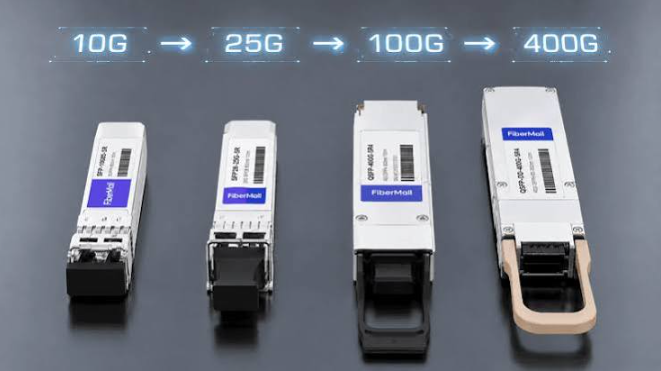
The optical transceiver industry has a habit of presenting generational transitions as clean, linear upgrades. In practice, they rarely are. The move from 800G to 1.6T Ethernet is exposing a structural divergence in the pluggable ecosystem that has less to do with raw bandwidth and more to do with physics, installed base, and the unglamorous economics of data center refresh cycles. Two credible paths have emerged: one preserves the mechanical lineage of the QSFP family with QSFP-DD1600, while the other expands the package into the OSFP ecosystem, split between OSFP 1.6T in its OSFP224 incarnation and the wider, lane-dense OSFP-XD. They all promise 1.6 Tbps at the faceplate. They disagree on nearly everything that determines whether a deployment succeeds two years after the first link is lit.
The Lane-Rate Cliff and Why 200G PAM4 Changes the Thermal Math
The single most consequential variable in the 1.6T transition is not the aggregate data rate. It is the per-lane signaling rate. An 800G module typically operates over eight electrical lanes at 100 Gbps PAM4. Pushing to 1.6 Tbps over the same eight-lane count requires 200 Gbps PAM4 per lane—a doubling that places severe demands on the module’s signal integrity and, critically, its thermal envelope. A 1.6T module in a QSFP-DD or OSFP224 cage is expected to dissipate roughly 28 watts per port, compared with about 16 watts for an 800G module in the same footprint. That additional heat must be removed from a cage sitting in the middle of an increasingly dense faceplate, where airflow is finite and every degree of junction temperature translates into either reduced reliability or forced clock throttling.
This is where 1.6T OSFP224 earns its keep in greenfield AI fabrics. The OSFP body is slightly larger than QSFP-DD, and that extra volume exists primarily as thermal headroom. The 1.6T OSFP224 specification adds an integrated heatsink to the module, optimizing system-level heat rejection rather than relying solely on the host cage’s thermal design. In hyperscale environments where ports run hot and continuously, that integrated thermal margin is not a luxury; it is the difference between sustaining line rate and living inside a temperature guard band.
See also: AI Vulnerability Scanner Analysis For Vulnerability Lifecycle Management
QSFP-DD1600’s Argument Is Not Thermal—It Is the Installed Base
QSFP-DD1600 takes the opposite engineering bet. It keeps the 18.35 mm width that has defined the QSFP family from QSFP28 through QSFP-DD800, preserving mechanical compatibility with a vast installed base of cages, connectors, and cabling. A QSFP-DD1600 cage accepts a QSFP-DD800, a QSFP-DD 400G, and even a QSFP28 module, engaging only the contact rows that legacy modules require. For an operator with thousands of 40G QSFP+ and 100G QSFP28 optics still in service, that backward compatibility has a tangible dollar value. A switch refresh does not automatically trigger a transceiver refresh on the same day, and a 1.6T-capable leaf can continue serving 40G or 100G servers during a staged migration.
The cost of that compatibility is thermal. Less body volume means less surface area to spread 28 watts of dissipation. QSFP-DD1600 is not thermally incapable—well-designed hosts have demonstrated reliable 800G QSFP-DD operation in dense configurations—but it works harder to achieve the same thermal result at 1.6T. The form factor’s advantage is density: a 1U switch can accommodate up to 36 QSFP-DD ports, compared with roughly 32 OSFP ports, because the QSFP-DD width is narrower. For brownfield aggregation layers and enterprises prioritizing port count and investment protection over absolute thermal ceiling, that density math is compelling.
OSFP-XD and the 100G-Lane Escape Hatch
The OSFP-XD complicates the binary. It is not simply a wider OSFP224. The “eXtended Density” design increases the electrical lane count from eight to sixteen, allowing a 1.6 Tbps module to operate over 16 lanes at 100 Gbps rather than eight lanes at 200 Gbps. This matters because the broader ecosystem’s transition to 224G-class SerDes is not uniform. Some switch silicon generations and host controllers will remain optimized for 100G-per-lane signaling longer than the leading edge adopts 200G lanes. OSFP-XD provides a 1.6T optical path without forcing every element of the electrical channel to leap to 200G PAM4 simultaneously. It also supports higher power delivery, with the specification targeting up to 40 W for future coherent and higher-reach applications. The trade-off is a distinct connector and cage ecosystem, which means OSFP-XD does not inherit the mechanical backward compatibility of either QSFP-DD1600 or OSFP224.
Standards, DSPs, and the Unfinished Work Beneath the Faceplate
None of these form-factor debates occur in a vacuum. 1.6T Ethernet as a MAC-layer standard is defined by IEEE P802.3dj, which has moved into final balloting and review, with ratification targeted for late 2026. The standard specifies 200 Gb/s lane operation and defines the electrical and management parameters that allow modules from different vendors to interoperate. Interoperability testing at this speed is substantially harder than at 800G: chip-to-module and module-to-module training must converge, and forward error correction operates at multiple points in the link.
Beneath the cage, the DSP has become the silent arbiter of whether 1.6T modules fit their thermal budgets. The shift to 3 nm CMOS DSPs has been decisive. Acacia’s Kibo 1.6T PAM4 DSP, designed for 200G-per-lane transmission, delivers roughly 20% lower power than earlier 1.6T implementations, and low-power variants have demonstrated sub-15 W operation in linear-drive configurations. Marvell’s 3 nm 1.6T platform similarly targets a 20% module power reduction through laser-driver integration and retimed-optics architectures. Without these DSP advances, the 28-watt thermal envelope of a QSFP-DD1600 or OSFP224 module would be unmanageable in dense faceplate configurations. The form factor sets the ceiling; the DSP determines how close to that ceiling the module can actually run.
The 1.6T transition is therefore not a single race toward a universal socket. It is a portfolio decision. OSFP224 prioritizes thermal headroom and is the natural fit for liquid-cooled or high-density AI fabrics where every port is expected to sustain line rate indefinitely. QSFP-DD1600 prioritizes backward compatibility and port density, making it the pragmatic choice for operators unwilling to strand their 40GBASE-LR4 QSFP+ and 100G investments. OSFP-XD serves as the bridge for ecosystems that need 1.6T aggregate throughput without an immediate jump to 200G electrical lanes. The engineering reality is that all three can coexist, and the optical interfaces defined by IEEE allow a QSFP-DD1600 at one end of a link to interoperate with an OSFP224 at the other. The form-factor war is not about whether 1.6T works. It is about which set of compromises a given data center can afford to live with for the next refresh cycle.