Summary
In this article, you’ll learn how industrial automation and robotics are transforming manufacturing and production across sectors like automotive, food, pharmaceuticals, and electronics. We cover how an industrial automation system works, why companies are adopting an industrial automation solution, and where automation and robotics technology deliver the most value on the factory floor.
The blog also explains real-world use cases, safety considerations, and common questions manufacturers ask before investing in industrial automation robotics. By the end, you’ll have a clear, practical understanding of how these technologies function and why they matter for modern industry.
Introduction
Factories today look very different from a decade ago. Robotic arms weld car frames, sensors track product quality in real time, and software coordinates entire production lines with minimal human input. This shift is driven by industrial automation and robotics, a combination of machines, software, and control systems designed to perform repetitive or complex tasks with precision.
Global installations of industrial robots have more than doubled over the past ten years, with over 542,000 units installed worldwide in a single recent year alone, according to the International Federation of Robotics, which reported that annual installations have topped 500,000 units for four straight years. This blog breaks down how these systems work, where they’re applied, and what businesses should know before adopting them.
Understanding the Core of Modern Industrial Automation Systems
An industrial automation system combines sensors, controllers, and software to manage machinery without constant human intervention. It reduces manual errors, increases consistency, and allows factories to run longer with fewer interruptions.
What Makes Up an Automation System
Automation systems typically include programmable logic controllers, sensors, actuators, and a central software layer. These parts communicate continuously to monitor conditions and adjust operations automatically.
How Data Flows Through the System
Sensors collect real-time data on temperature, speed, or pressure. This information feeds into controllers that make instant decisions, keeping production consistent without manual checks.
Why Reliability Matters
Downtime is costly. A well-designed system includes redundancy and predictive maintenance features, so potential failures are flagged before they disrupt the entire production line.
Human Oversight Still Plays a Role
Even advanced systems need skilled operators to monitor performance, troubleshoot issues, and fine-tune processes. Automation supports human decision-making rather than fully replacing it.
How Robotics Technology Is Reshaping Production Floors
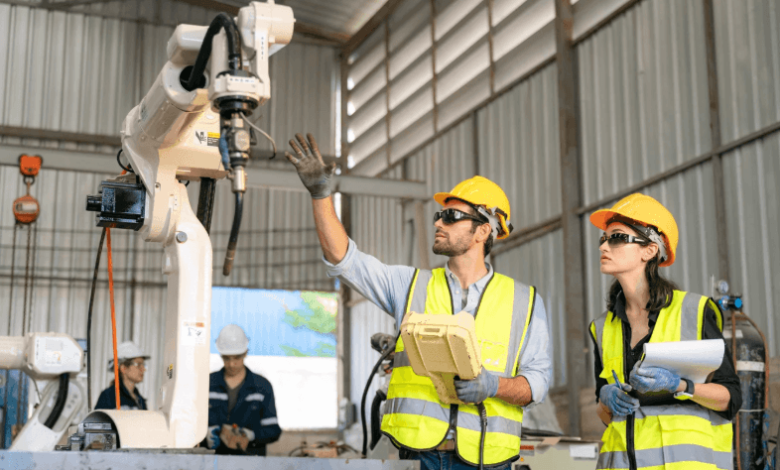
Automation and robotics technology have moved beyond simple repetitive tasks. Modern robots now handle delicate assembly, precise measurements, and adaptive movements guided by vision systems and machine learning.
Robotic Arms and Precision Assembly
Robotic arms can repeat the same motion thousands of times with minimal deviation, making them ideal for tasks like circuit board assembly or precise component placement.
Vision-Guided Robotics
Cameras and image-processing software allow robots to identify object orientation and defects, adjusting their grip or movement in real time without reprogramming.
Collaborative Robots on the Shop Floor
Collaborative robots, or cobots, work alongside human employees safely. They handle repetitive or strenuous tasks while people focus on judgment-based work.
Adaptive Robotics for Changing Products
Some robotic systems can switch between product variants automatically, reducing downtime when manufacturers need to shift production quickly between different items.
Where Industrial Automation Solutions Are Applied Across Industries
An industrial automation solution looks different depending on the sector. Automotive plants prioritize speed and strength, while pharmaceutical facilities emphasize cleanliness and precision. Each industry adapts automation to its unique demands.
Automotive Manufacturing
Car manufacturing relies heavily on robotics for welding, painting, and assembly. Automation ensures consistent quality across thousands of vehicles while reducing worker exposure to hazardous tasks.
Food and Beverage Processing
Automation handles sorting, packaging, and quality checks in food production. Gentle handling systems prevent damage to fragile items while maintaining strict hygiene standards throughout the process.
Pharmaceutical and Medical Manufacturing
Precision matters most here. Automated systems fill, seal, and inspect products under controlled conditions, minimizing contamination risk and ensuring dosage accuracy for every unit produced.
Electronics and Semiconductor Production
Micro-level assembly of circuit boards and chips requires extremely accurate robotics. Automation reduces human error in tasks too small or repetitive for manual handling.
Logistics and Warehouse Operations
Automated guided vehicles and robotic sorting systems move goods efficiently within warehouses, reducing manual labor and speeding up order fulfillment across distribution centers.
See also: Business Owners: What to Look for in Contact Center Software Platforms
Why Businesses Are Investing in Industrial Automation Robotics Today
Industrial automation robotics offers measurable returns: fewer errors, faster cycle times, and safer working conditions. Companies adopting these systems often see improved output consistency and reduced long-term operating costs.
Improved Workplace Safety
Robots take over hazardous tasks like heavy lifting, high-heat processes, and repetitive strain work, significantly lowering workplace injury rates in demanding manufacturing environments.
Consistent Product Quality
Automated systems reduce variability caused by fatigue or manual error, ensuring each unit produced meets the same quality standard, batch after batch.
Scalability for Growing Demand
Automated lines can often scale production up or down more easily than manual labor alone, helping manufacturers respond to shifting market demand.
Long-Term Cost Efficiency
While upfront investment is significant, reduced waste, fewer errors, and lower injury-related costs often make automation financially worthwhile over time.
Challenges Companies Face When Adopting Automation Technology
No transition is without hurdles. Integrating new systems into existing infrastructure requires planning, training, and ongoing technical support to avoid costly disruptions.
Integration With Legacy Equipment
Older factories often use equipment that wasn’t designed for modern automation. Bridging this gap requires custom interfaces or gradual system upgrades.
Workforce Training Requirements
Employees need training to operate, maintain, and troubleshoot new systems. Without proper skill development, automation investments may underdeliver on expected results.
Upfront Investment Costs
Automation systems require significant initial capital. Businesses must weigh long-term efficiency gains against the immediate financial commitment involved.
Delivering Precision Engineering Through Toolholding, Gripping, and Automation Expertise
Some of the most demanding automation challenges involve extreme precision, from processing micro-optical components as thin as a human hair to safely handling delicate food items on packaging lines. SCHUNK addresses exactly these kinds of problems. With deep expertise in toolholding, workholding, and gripping technology, SCHUNK supplies both individual high-tech components and complete intelligent solutions for robot systems and broader production processes.
Rather than offering isolated parts, the company focuses on integrated robotics and automation technology solutions built around each customer’s specific application, whether that means milling implant surfaces with anatomical accuracy or gently transferring fragile products without damage, all delivered from a single source.
Key Takeaways
● Industrial automation and robotics improve speed, consistency, and safety
● Modern robots use vision systems for adaptive, precise movements
● Industrial automation solutions vary by industry and application needs
● Automotive, food, and pharma sectors each apply automation differently
● Cobots allow humans and robots to work safely together
● Integration with older equipment remains a common adoption challenge
● Workforce training is essential for successful automation rollout
● Long-term cost savings often outweigh initial investment costs
Conclusion
Industrial automation and robotics continue to reshape how products are made, tested, and delivered across nearly every major industry. From automotive assembly lines to pharmaceutical packaging, automation improves precision, reduces workplace risk, and helps manufacturers keep pace with growing demand. While challenges like integration and training exist, the long-term benefits often outweigh these hurdles for businesses ready to modernize.
As robotics technology continues advancing, adaptable and intelligent automation systems will likely become even more central to global manufacturing. Understanding how these systems work and where they fit best helps businesses make informed, practical decisions about their own automation journey moving forward.
Frequently Asked Questions
1. What is the main purpose of industrial automation and robotics?
The main purpose is to perform repetitive, precise, or hazardous tasks more consistently than manual labor. This improves product quality, reduces workplace injuries, and increases overall production efficiency. It also allows human workers to focus on supervision, quality control, and decision-making rather than repetitive physical tasks.
2. How is an industrial automation solution different from basic machinery?
Basic machinery performs fixed tasks without adapting to changes. An industrial automation solution integrates sensors, software, and controllers that monitor conditions and adjust operations automatically, offering flexibility, real-time feedback, and reduced need for constant manual supervision during production.
3. Are cobots the same as traditional industrial robots?
No. Traditional industrial robots typically operate in isolated, caged environments due to speed and force. Collaborative robots, or cobots, are designed with safety features that allow them to work directly alongside human employees without physical barriers separating them.
4. Which industries benefit most from automation technology?
Automotive, food and beverage, pharmaceuticals, electronics, and logistics see significant benefits. Each industry uses automation differently, from precision welding in vehicles to sterile packaging in pharmaceuticals, but all gain improved consistency, safety, and production speed.
5. Is automation replacing human workers entirely?
Not entirely. Automation typically handles repetitive or hazardous tasks, while humans focus on oversight, troubleshooting, and decision-making. Most facilities use a combination of human expertise and automated systems rather than fully removing human involvement from operations.