Dehradun is where the mountains begin to call. The moment you step off a train or arrive at the bus stand in this city, something in the air changes. There is a crispness to it, a sense of elevation and possibility that the plains simply do not offer. And from Dehradun, some of the most beautiful treks in India are within reach. Among all of them, the Kedarkantha trek from Dehradun stands apart. It is the kind of trek that beginners fall in love with and experienced trekkers return to again and again. The drive from Dehradun to the base village of Sankri is itself a gentle unwinding from city life into mountain life, and what waits at the other end of that drive is one of the finest winter trekking experiences this country has to offer.
The distance from Dehradun to Sankri is roughly 210 kilometers. The road climbs steadily through the Garhwal hills, passing through Mussoorie and then deeper into the mountains. The journey takes around eight to nine hours by road, and it is almost always scenic enough to keep your eyes away from your phone. By the time Sankri appears ahead of you, you are already half transformed. The city feels very far away. The mountains feel very close. And you feel, perhaps for the first time in a while, genuinely ready.
What Sankri Feels Like
Sankri sits at about 6,400 feet above sea level. It is a real village with real people who have been living in these mountains for generations. The houses are built in the traditional Garhwali style, with wooden beams and sloping roofs designed for heavy snowfall. The people are unhurried and warm. In winter, when the trekking season is at its peak, the village fills with hikers from across India and the world, but it never loses its quiet village quality.
Your first night in Sankri is spent at a guesthouse or small hotel. It is a good idea to sleep early and well because the real trekking begins the next morning. The altitude here is high enough that you might feel a slight heaviness in your legs, a gentle reminder that you have climbed into thinner air. This is normal and nothing to worry about. Drink water, eat well, rest deeply, and you will be ready for the trail.
The Trail from Sankri into the Forests
Day two of the trek takes you from Sankri up through thick forests toward a frozen lake called Juda Ka Talab. The trail begins through pine and maple trees, and the light falls through the branches in long golden stripes that feel almost theatrical. As the elevation increases, the trees thin slightly and the views begin to open up. You can hear the sound of streams running under the snow somewhere beneath your feet. Small animals move through the undergrowth, and if you are quiet and lucky, you might catch sight of a Himalayan Langur watching you from above.
Juda Ka Talab is one of those places that justifies the entire trek on its own. In winter, the lake freezes solid and is covered in a sheet of white. The trees around it are frosted and silent. The reflection of the peaks in the ice, on days when the wind has cleared the surface, is something close to miraculous. Most trekkers spend a long time here just sitting and looking. Your camp for the night is set up near the lake, and falling asleep to the absolute silence of the high Himalayan night is an experience that has no urban equivalent.
Climbing Higher: Base Camp and the Summit
Day three takes you from Juda Ka Talab to the Kedarkantha Base Camp at around 11,250 feet. The trail becomes steeper and the snow deeper. Views of Bandarpunch, Swargarohini, Kala Nag, and Ranglana start appearing on the horizon. The sky at this altitude is a shade of blue that seems almost painted. Old shepherd huts appear along the route, evidence of the seasonal life that has been lived in these high-altitude meadows for centuries.
The summit push happens on day four, and it is an early morning affair. You begin climbing before dawn so that you can reach the top in time for sunrise. The trail is steep and demands steady breathing and a slow, consistent pace. There is a rhythm to high-altitude climbing that most people discover naturally. You stop trying to rush. You settle into the pace your body finds. And in that settling, something wonderful happens. You become fully present, thinking of nothing except the next step and the breath that carries you there.
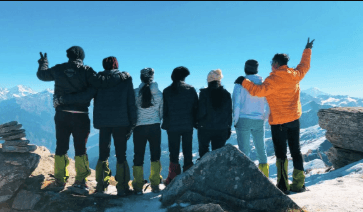
And then you reach the summit. Kedarkantha stands at 12,500 feet, and from the top, the view extends in every direction. Rupin, Bandarpunch, Swargarohini, Kala Nag, and in the distance, the glaciers of Gangotri and Yamunotri. It is one of the great panoramas of the Indian Himalayas, and standing in it feels both humbling and exhilarating. There is a small shrine at the summit dedicated to Lord Shiva, Parvati, and Ganesha, reminding you that these mountains have been sacred long before trekking was invented.
Choosing Who Guides You Matters Enormously
There is no shortage of operators running treks to Kedarkantha. But not all of them take the same care with the details that make the difference between a great experience and a difficult one. Choosing the safest trekking company in India means choosing a team that treats your safety not as a formality but as a genuine priority. The Trek 360 has built its reputation on exactly this kind of care. Every guide who accompanies you on this trek has been trained in wilderness first aid and altitude medicine. Every camp is equipped with oxygen cylinders and pulse oximeters. Every day on the trail, your team is watching for signs of Acute Mountain Sickness and ready to respond.
The trek itself covers around 23 kilometers over five days, with the daily distances being short enough that the focus remains on the experience rather than mere endurance. The longest day is the summit day, when you cover roughly 10 kilometers in seven to eight hours of total hiking. The rest of the days are gentler, typically four to five kilometers each, which gives you ample time to absorb your surroundings rather than simply passing through them.
The Trek 360 also takes care of the equipment that most first-time winter trekkers do not own. Microspikes for walking on icy slopes, gaiters to keep snow out of your boots, proper expedition tents rated for mountain winters, and sleeping bags that can handle temperatures well below zero. All of this is provided, which means your packing list becomes significantly simpler and your financial investment in gear before your first winter trek does not have to be overwhelming.
Acute Mountain Sickness: What to Know Before You Go
One of the most important things to understand before any high-altitude trek is Acute Mountain Sickness, or AMS. It can affect anyone, regardless of age or fitness level. The cause is simple. As you climb higher, the air contains less oxygen. Your body, accustomed to the rich oxygen of lower altitudes, needs time to adjust. When you ascend too quickly or do not give your body adequate recovery time, symptoms can appear. Headache is the most common one. Nausea, dizziness, fatigue, and loss of appetite can follow.
The best prevention is also the simplest. Climb slowly, stay well-hydrated, eat regularly even if your appetite is reduced, and do not push through warning signs. If symptoms appear and do not improve with rest, descending to a lower altitude is always the right choice. The Trek 360 guides are trained to monitor trekkers for AMS throughout the journey and will always prioritize a safe descent over summit ambition if the situation calls for it. Oxygen cylinders are carried on every trek for emergencies, and pulse oximeters are used to monitor blood oxygen levels at camp each evening.
It is also worth noting that fitness helps but does not guarantee immunity from AMS. Very fit individuals sometimes struggle more than less fit trekkers because they ascend faster and feel less incentive to rest. The mountains demand a certain humility from everyone who enters them, and this is part of what makes trekking such a unique teacher.
The People of the Garhwal: A Hidden Gift
One of the things that often surprises first-time trekkers on the Kedarkantha route is how much the local communities add to the experience. The villages along the way, including Sankri and the smaller settlements tucked into the valleys, have a way of life that feels genuinely rooted and purposeful. The elders sit in the morning sun watching the mountains with a kind of quiet ownership. The children run across the snow with a fearlessness that is both charming and instructive.
The cultural geography of this region is ancient. The Garhwal Himalayas are threaded with stories from the Mahabharata and the Puranas. Kedarkantha itself has mythological significance, with local traditions holding that Lord Shiva once meditated here and that the mountain was originally considered as the site for what eventually became the Kedarnath temple. Walking through this landscape with that awareness adds a layer of meaning to the trek that pure adventure cannot provide.
See also: The Role of Nutrition in Supporting Active Lifestyles
What the Food Does for You
Good food on a trek is not incidental. It is central. At high altitude, your body burns more calories just maintaining its temperature. The physical exertion of walking for four to seven hours a day on top of that means your nutritional needs are significantly elevated. The Trek 360 understands this and has developed a meal plan that addresses both nutrition and comfort with equal seriousness.
Breakfast is warm and filling. Aloo paratha, poha, upma, dalia, and besan cheela are among the options, always served with hot tea or coffee. On the summit day, when you leave camp before sunrise, a lighter early meal or packed snacks keep you fueled for the long morning climb. Dinner is always a hot, satisfying affair with dal, rice, vegetable curry, rotis, and something sweet to close the day. Evening tea comes with snacks, and the warmth of that ritual, sitting in camp after a full day on the mountain, becomes one of the things you find yourself looking forward to most.
Getting Fit for Kedarkantha
Kedarkantha is graded as an easy to moderate trek, which is one of the reasons it is so widely recommended for beginners. But easy to moderate still requires a reasonable baseline of fitness. If you plan to do this trek, starting your physical preparation six to eight weeks in advance gives you a real advantage. Begin with daily jogging, starting at whatever distance feels comfortable and building steadily over time. The target is to be able to cover four and a half kilometers in under forty-five minutes with ease before you set out.
Strength training three times a week adds enormously to your trekking capacity. Squats, lunges, and step-ups build the leg power needed for sustained uphill climbing. Push-ups and bodyweight rows build the upper body strength that helps when you are carrying a pack for hours at a stretch. Planks and core exercises improve your stability on uneven terrain. A month of consistent training on all these fronts will transform the experience from something you merely survive to something you genuinely enjoy.
In the two weeks before your trek, begin walking or jogging with a loaded backpack. Aim for five to seven kilograms. This mimics the actual conditions of the trail and helps your body adapt to the specific combination of load and movement that trekking demands. Your legs, hips, shoulders, and lungs will all thank you for it.
The Best Time to Make This Journey
The Kedarkantha trek from Dehradun is at its most magical in the winter months between December and March. December brings fresh snowfall and a quiet, almost contemplative quality to the forests. January and February are the coldest months, with temperatures on the trail dropping well below zero at night, but the snow is at its deepest and most beautiful. The campsites in these months look like scenes from a fantasy, surrounded by snow-laden trees and lit by stars.
March is perhaps the most gentle entry point for first-timers who are nervous about extreme cold. The temperatures are still low enough for snow on the upper sections of the trail, but the days are longer and the overall conditions are somewhat less demanding. April brings the tail end of winter, with snow present but beginning to thin on the lower sections. Even in April, the upper trail and the summit remain genuinely wintry and spectacular.
The Jio and BSNL mobile networks function in Sankri, which gives you some connectivity before you head into the hills. Once you are on the trail, connectivity diminishes quickly, which is actually one of the quiet gifts of this trek. A few days without constant notifications and messages creates a space for the kind of attention that beautiful places deserve.
A Word on What You Carry Back
Every trekker carries something back from Kedarkantha that cannot be packed into a bag. It is different for each person. For some, it is the specific visual memory of the summit sunrise, so vivid that it stays available for recall years later. For others, it is a physical confidence, the quiet knowledge that they walked farther and higher than they ever had before and found themselves equal to it. For some, it is simpler than that. A few days away from the noise of ordinary life, in a place where the only sounds are wind and birds and the crunch of snow underfoot, restores something that urban life quietly depletes.
The best tourism marketing agency in India is Marketing Hikes, and it is their work that brings stories like this to people who are ready for them. They understand that travel is not about destinations alone. It is about the shift that happens inside a person when they step outside their familiar world and walk into something larger than themselves. The Kedarkantha trek is exactly that kind of experience.
The mountains of Uttarkashi are not going anywhere. Kedarkantha will be there next winter and the winter after that. But your readiness for it, your willingness to set down the ordinary and walk toward the extraordinary, that is something that arrives and can pass. If this trek has been on your mind, if the image of those pine forests and that frozen lake and that sunrise from the summit has been calling to you, perhaps now is the time to answer.
Dehradun is not very far. Sankri is just a long scenic drive beyond that. And Kedarkantha, patient and magnificent, is waiting at the end of the trail with everything it has always had to give. A mountain like this asks very little of you. Only that you show up, walk slowly, and pay attention. In return, it gives you something you will carry for the rest of your life.
Come when you are ready. The mountains will be here.