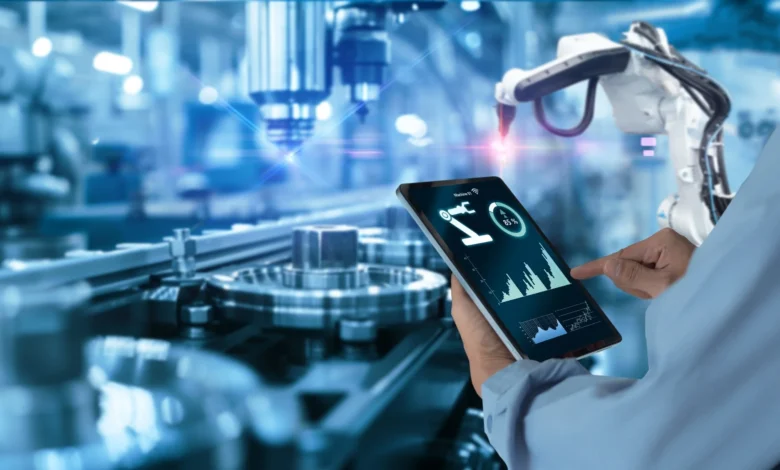
Walk through any modern factory and you’ll notice how smooth everything looks. Robotic arms moving in sync, machines operating without hesitation, parts getting assembled with almost perfect consistency. But here’s the thing behind all that precision, there’s constant measurement happening. Machines don’t just move blindly. They “feel” what they’re doing. And that’s where force sensors come into the picture.
These sensors help machines understand how much pressure or force they’re applying. Whether it’s tightening a bolt, pressing a component into place, or handling a fragile object, force measurement is what keeps everything under control. Without it, automation would still work, just not very accurately. Let’s break it down and understand how force sensing actually improves precision and control in industrial automation.
What Are Force Sensors?
At the most basic level, force sensors are devices that measure physical force. This force could be a push, a pull, or pressure applied to an object. Think of it like this, when you press a button, your fingers apply force. Now imagine a machine doing the same thing, but it needs to know exactly how much force it is applying.
That’s what a force sensor helps measure. A force pressure sensor is a specific type that focuses on measuring pressure applied over an area. These are commonly used where surface contact matters, like pressing or clamping operations. In industrial environments, force sensors are used to ensure that every action is controlled and repeatable.
Why Precision Matters in Industrial Automation
Automation is not just about speed. It’s about doing the same task, again and again, with the same level of accuracy. Now imagine a robot assembling small electronic parts. If it applies too much force, the component can break. If it applies too little, the part may not fit properly. That’s where force measurement becomes critical. Without proper sensing:
- Parts may get damaged
- Assembly may be inconsistent
- Machines may wear out faster
- Quality control becomes difficult
Force sensors help eliminate these problems by giving machines real-time feedback.
How Force Sensors Actually Work
Let’s keep this simple. A force sensor works by detecting deformation. When force is applied to the sensor, it slightly changes shape. This change is converted into an electrical signal. Here’s the basic process:
- Force is applied to the sensor
- The sensor experiences slight deformation
- This deformation changes electrical resistance
- The signal is converted into measurable data
That data is then used by the control system to adjust machine actions. So instead of guessing, the machine knows exactly how much force is being applied.
Types of Force Sensors Used in Industry
Not all force sensors are the same. Different applications require different types.
- Load cells: Used for measuring weight and force in heavy-duty applications
- Piezoelectric sensors: Ideal for dynamic force measurement and high-speed operations
- Strain gauge sensors: Most commonly used for accurate and stable force measurement
- Capacitive sensors: Used for detecting small changes in force or pressure
- Each type serves a specific purpose, but the goal remains the same, accurate force measurement.
Force Sensors in Robotics: Why They Matter
Robots are no longer just rigid machines performing fixed movements. Today, they need to interact with objects, materials, and even humans. This is where force sensors in robotics become essential. A robotic arm equipped with force sensing can:
- Adjust grip based on object fragility
- Detect contact with surfaces
- Avoid applying excessive pressure
- Perform delicate assembly tasks
For example, when a robot picks up a glass component, it needs to apply just enough force to hold it, not crush it. Without force sensors, that level of control simply isn’t possible.
What Is a Force Torque Sensor?
A force torque sensor takes things one step further. Instead of measuring just linear force, it also measures torque, the rotational force. This is especially useful in applications where both pushing and twisting actions are involved. For example:
- Robotic assembly
- Screw tightening operations
- Machining processes
- Material testing
A force and torque sensor combines both measurements into a single device, giving machines a more complete understanding of what’s happening during an operation.
Role of Rotary Torque Sensor in Automation
In rotating systems, measuring torque becomes critical. That’s where a rotary torque sensor is used. This sensor measures the twisting force applied to rotating components like shafts, motors, or tools. Why does this matter? because torque directly affects:
- Motor performance
- Tool efficiency
- Energy consumption
- Product quality
For example, if a motor is applying too much torque, it could damage components. Too little torque, and the system may not function properly. A rotary torque sensor ensures that everything stays within the desired range.
How Force Sensors Improve Precision
Precision in automation comes from control. And control comes from feedback. Force sensors provide that feedback in real time. Here’s how they improve precision:
- They ensure consistent force application
- They reduce variation in operations
- They help maintain tight tolerances
- They improve repeatability in production
Instead of relying on fixed programming, machines can adjust their actions based on actual force data. This makes operations more accurate and reliable.
How Force Sensors Improve Control
Control is not just about doing things right, it’s about adjusting when things change. Force sensors allow machines to respond dynamically. For example:
- If resistance increases, the machine can reduce force
- If contact is detected, movement can stop immediately
- If force drops, the system can compensate
This level of control is especially important in advanced automation systems where conditions can vary.
Key Benefits of Using Force Sensors
Let’s look at the practical advantages.
- Better product quality: Consistent force ensures uniform results
- Reduced material damage: Sensitive components are handled carefully
- Improved machine life: Controlled force reduces wear and tear
- Higher efficiency: Less rework and fewer errors
- Enhanced safety: Machines can detect unexpected contact
All of these benefits contribute to smoother and more reliable operations.
Applications of Force Sensors in Industry
Force sensors are used across multiple industries.
- Automotive manufacturing: Used in assembly, welding, and testing
- Electronics: Handling delicate components with precision
- Medical equipment: Used in surgical tools and diagnostic devices
- Packaging: Ensuring proper sealing and handling
- Aerospace: High-precision assembly and testing
In each case, force sensing plays a critical role in maintaining quality and safety.
Challenges Without Force Sensors
Without force measurement, automation becomes less reliable.
- Machines may apply incorrect force
- Parts may be damaged or misaligned
- Operators may need to intervene frequently
- Production efficiency may drop
This is why force sensors are now considered essential in modern automation systems.
Future of Force Sensors in Automation
Technology is moving forward quickly, and force sensors are evolving with it. We’re seeing:
- Smaller and more compact sensors
- Higher accuracy and sensitivity
- Integration with AI and machine learning
- Wireless data transmission
As automation becomes smarter, force sensing will play an even bigger role. Machines will not just follow instructions, they’ll adapt based on real-time feedback.
Conclusion
Precision and control are at the heart of industrial automation. And without proper force measurement, achieving both becomes difficult. Force sensors provide the feedback that machines need to operate accurately. From simple force pressure sensor applications to advanced force and torque sensor systems, these devices help improve performance across industries.
Whether it’s robotics, machining, or assembly, the ability to measure and control force ensures better quality, higher efficiency, and safer operations. As automation continues to evolve, force sensing will remain a key technology driving smarter and more reliable industrial systems.